Casino
How to Play Blackjack: A Card Counter’s Complete Guide

Blackjack is one of the easiest casino games to play at William Hill Vegas and Michael Kaplan is here to provide his expert guide on card counting.
Do you know your blackjack dealer rules? How about your blackjack side bet payouts? And what exactly is the difference between Spanish 21 and blackjack?
Having played on a high-stakes card counting team for several years, still playing blackjack actively and recently authoring Advantage Players: Inside the Winning World of Casino Virtuosos, Master Strategists, and Mathematical Wizards, I am considered an expert at the game. Some of my blackjack insights are shared below.
Unlike many other casino card games, blackjack can be played in a manner that is simple (by employing basic strategy) or more complex (through advantage plays such as card counting, which is legal but frowned upon by casino managers). At its core, blackjack (also known as 21) is a card game where you aim to beat the dealer by getting a hand total as close to 21 as possible without going over.
While we’re offering you a guide to the game, nothing beats the experience you can get by buying in for real money and playing at the blackjack tables of William Hill.
Beating blackjack and stacking chips
Play to get as close to 21 as possible without going over. When your cards are closer to that magic number than the dealer’s cards are – without going over – you win.
Keep in mind that if you consistently play perfect basic-strategy, the casino will have around a 0.5% edge, but an edge nevertheless and it does add up. That advantage comes from the fact that the player must act first. When the player’s cards exceed 21, the house wins regardless of the dealer’s outcome.
Rules of the game
Here is how blackjack plays on the William Hill site and at a brick-and-mortar casino.
Putting it up
Players put up chips. As to how much can be wagered, there is always a minimum and maximum amount. For novices, it is a good idea to start small.
The dealer’s job
Cards are shuffled (usually via an automatic shuffling machine) and a yellow cut card is inserted near the bottom of the cards to be dealt.
In single and double deck games, the cards are usually dealt from decks held in the dealer’s hand (these are known as pitch-games). For six or eight deck games, which are played out of combined decks, the dealer divvies cards from a plastic case that is known as a shoe. After each round, played cards get stacked in a plastic tower that is called a discard tray.
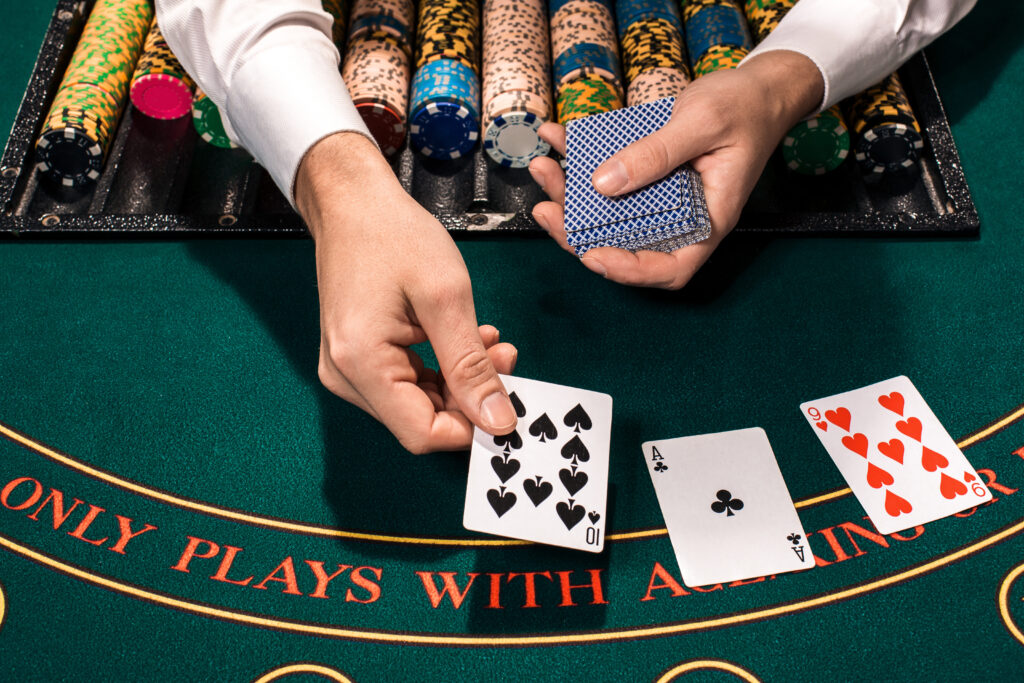
Casino, gambling, poker, people and entertainment concept – close up of holdem dealer with playing cards and chips on green table
Cards in the air
Each player and the dealer receive two cards. Yours will be face up in shoe games and dealt down in pitch games; the dealer will have one face up and the other face down.
“Winner, winner, chicken dinner!”
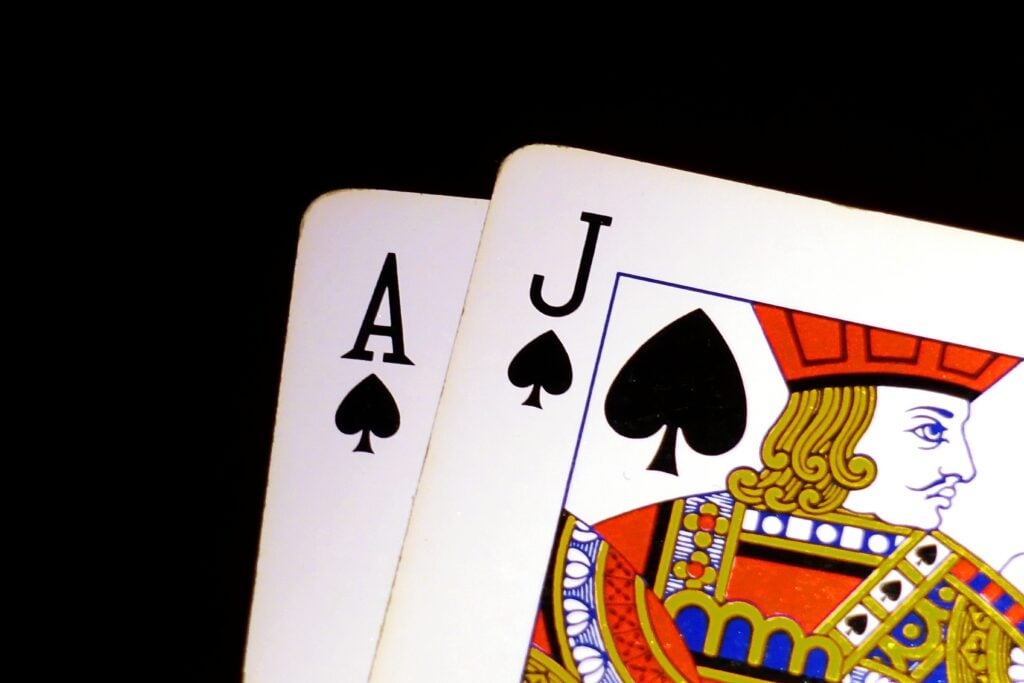
This is what you might say if you are dealt an Ace and a 10-value card. It totals 21out of the gate and is known as a “blackjack” or a “natural.”
If the dealer does not have a blackjack of their own, it’s an automatic win for the player and pays 3-2 (£15 on a £10 bet) or 6-5 (£12 on a £10 bet). Obviously, the former is preferable. But each casino sets its own payout structure.
Play the game
Once cards are on the table, players signal whether they want to hit (tapping the table to signal getting another card in shoe games) or stick (waving your open hand over the cards to signal staying pat in shoe games).
Pay that man his money…
If the player’s hand is closer to 21 than that of the dealer, he gets paid as much as he bet. If not, then the dealer wins. And if the player busts (that is, draws to more than 21), the dealer wins the player’s chips.
Put up your chips
Before the start of each round, the player puts up his wager. It must conform with the minimum and maximum bets at the table.
Usually, there is a 100x spread. So, if you are playing at a £100 minimum table, the max bet will be £10,000. If the minimum is £10, don’t expect to bet more than £1,000 per hand.
Card values
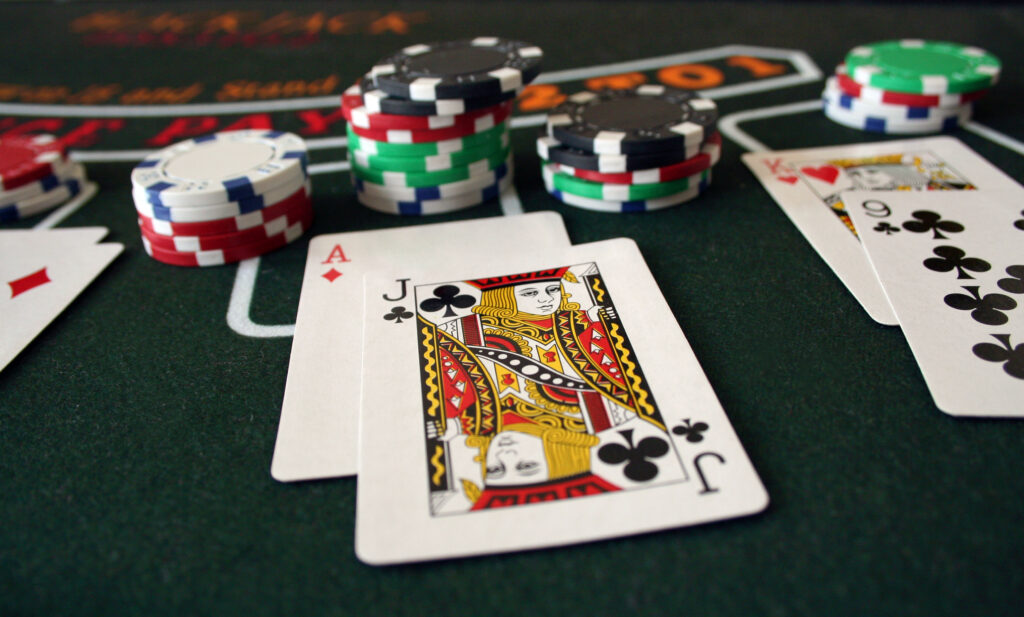
Each numerical card gets counted at its advertised value. Picture cards equal 10. Aces can be 1 or 11, depending on what gets you closer to 21 without going over.
For example, if you are dealt 10, 6 and draw an Ace, you will count it as 1 for a respectable 17. On the other hand, if you have 5, 5 and are lucky enough to receive an ace, count it as 11 for a smooth 21.
Hit or stick
Those are the two primary decisions that get made. When you hit (signaled by tapping the table in a shoe game), you are requesting another card. When you stick, or stand, (signaled by waving your fingers over your cards in a shoe game), you are staying pat.
Our basic strategy guide will clue you in on optimal moments for hitting or sticking.
Say no to insurance
When the dealer’s up-card is an ace, he will ask if you want insurance. Unless you’re a card counter, who understand how to correlate the count with whether or not to insure, insurance is something to steer clear of.
Say yes to doubling down
In certain situations – say, when you are dealt a 10 and the dealer shows a 6 – doubling down is financially wise.
As the name of the play implies, you put up more chips to double your bet and take just one card. If you have 11 and the dealer is showing a six, for example, doubling down is the sharp move.
Check out William Hill’s basic strategy guide for all optimal doubling down situations.
What is a soft hand vs a hard hand in blackjack?
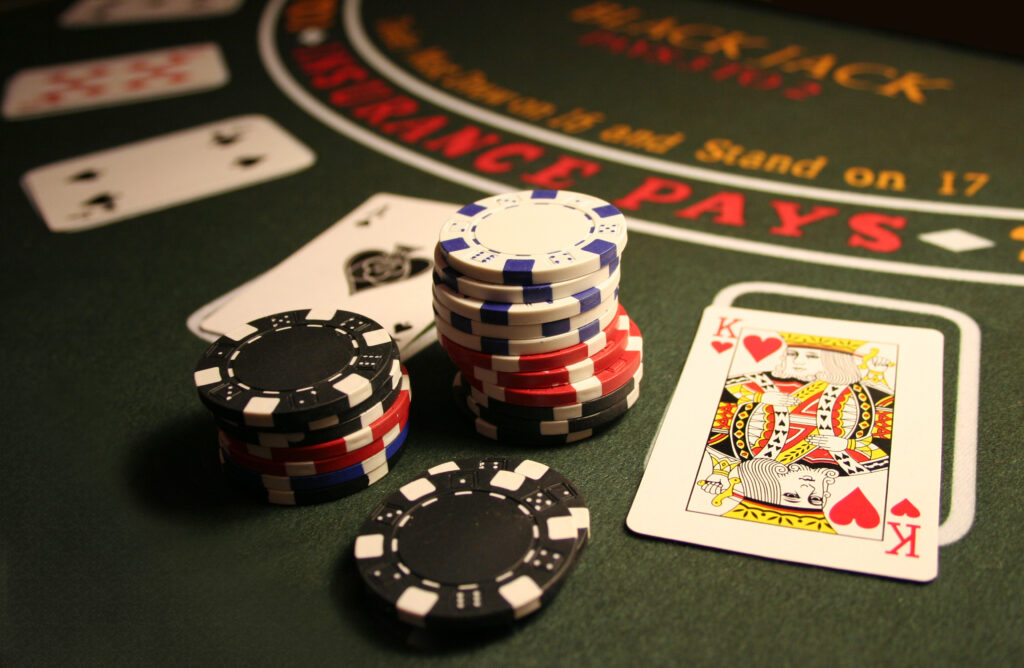
Soft hands are where your opening total is informed by an Ace. Ace, 5, for example, is known as a soft 16. It can be played either as 16, with the Ace counting as 11, or 6, with the ace counting as 1.
Take a hit and see what happens. Draw a five and you have a 21. Draw an 8 and you give yourself a 14.
Conversely, a 10-value care and a 6 is known as a hard 16. It can’t be anything but that. Draw a five, thank whatever force brings you good cards in blackjack, and settle in with a 21. Draw an 8 and you have a 24. You’ve gone over 21 and lost the hand.
When it comes to blackjack, soft is preferable to hard.
What is the soft 17 rule?
If a dealer gives himself Ace, 6, which is known as a soft 17, the dealer must hit or stand, depending on the particular casino’s rules.
It’s worth noting that in casinos where the dealer must count the A, 6 as 17 and stand, the house edge is 0.2% lower than in casinos where the dealer hits. Must-stand is obviously good for the player, which accounts for the limited number of casinos where that rule is in place.
Surrender
Some casinos allow you to give up before you even start. This is a move know as surrendering. You sweep an index finger across your cards from above and give up half your bet.
As per basic strategy, players should do it with a hard 16 against the dealer’s 9, 10 or Ace. You should also do it with a hard 15 against a dealer 10 or Ace.
This decision gets announced after the dealer checks for blackjack. If he has a blackjack, your chance to surrender is gone, along with your chips.
Early surrender
Rarely, casinos offer early surrender, which is advantageous to players. It allows you to give up before the dealer checks for blackjack. That way, you lose only half your bet even if the dealer has a BJ.
This move is so valuable that card counters have an array of deviations from basic strategy in order to optimize the opportunity. Under those conditions, the counters play at an advantage from the outset.
If you find an early surrender game, please contact me and let me know where it is.
Split ‘em if you got ‘em
When you get dealt two cards of the same denomination, you can split them into two hands. You put up a fresh bet on the second hand and receive fresh cards so that you have two sets of starting cards and two hands to play. If a duplicate card drops again, you can re-split.
What happens when you split Aces?
With Aces, you receive only one card on each hand.
Advice: Hope like mad for a 10-value card, even though blackjacks on split Aces pay even money for each instance. But don’t worry. Getting a pair of 10s after splitting Aces is a beautiful thing.
Blackjack sidebets
21 + 3
If you want to combine poker with blackjack, this bet is for you. It’s a wager on whether your two cards and the dealer up card will combine to make a desirable three-card poker hand.
Here is what you are going for and the payoff you will receive:
- Flush – three cards of the same suit (pays 5-1)
- Straight – three cards in sequence (pays 10-1)
- Three of a kind – three cards of the same rank (pays 30-1)
- Straight flush – three cards in sequence, all of the same suit (pays 40-1)
- Suited trips – three cards of the same rank and the same suit (pays 100-1)
Perfect Pair
This is a bet that the two cards you get dealt will be a pair. That provides the opportunity to split on top of winning a side bet!
- Mixed pair – two cards of the same rank but different colors (pays 5-1)
- Colored pair – two cards of the same rank and color (pays 10-1)
- Perfect pair – an identical pair; for example, two Kings of diamonds (pays 30-1)
Looking to give the 21+3 or Perfect Pair side bets a go? Try our exclusive William Hill Mayfair Blackjack and other online blackjack games at William Hill Vegas.
Blackjack variations
European Blackjack
In standard blackjack, the dealer checks for blackjacks before the round gets played. If the dealer is dealt a BJ, they win and play ends.
In the European version, the dealer receives one up card at the start of play. They get their second card after play ends. This means that they do not check for blackjack until the round is over. All player hands lose (except for blackjacks, which push) and all double-downs, splits, etc. go to the dealer.
As a result, players have opportunities to lose more than their initial bets. Not great for the players.

European Union casino theme. Aces in poker game, cards and chips on red table with national flag background. Gambling and betting.
Blackjack Switch
Players are dealt two hands and can swap top cards from one to the other. This is done to enhance both hands. On the downside, blackjacks pay even money and a dealer 22 pushes against all player hands – except for blackjacks.
Spanish 21
All 10s are removed from the deck (though picture cards remain), which increases the house edge. On the upside, you can re-double down, which is great if you double with a 9 and draw a 2.
Double Attack Blackjack
Think of this as Spanish 21 on steroids.
It follows the same rules with two additions: Players can double their original bets after seeing the dealer’s up-card and they can take a “buster” side bet. This is a wager that the dealer will go over on their third card. That bet must be made before the dealer’s up card is dealt.
Free Bet Blackjack
This is a variation in which players take the good with the bad.
On the good side of things, double downs and splits are covered by the casino. Those are tremendous. On the other side, if the dealer hits a 22, all bets push.
This may not sound like that big of a deal, but it is. With the 22 feature, the house edge doubles.
California Blackjack
If you dream of being the house, this is the game for you. In California Blackjack, players take turns banking the game (essentially being the house).
But the game itself plays a little differently than standard blackjack.
For starters, rather than playing with six 52-card decks, each deck has 53 cards due to the addition of jokers, which can assume any point value to bring the recipient to 21. Hence, if you are dealt a 6 and a joker, count the joker as 15. That will give you a 21. If the banker gets a joker, the hand ends (in the banker’s favor) and players with blackjacks of their own will push.
Blackjacks, or naturals, with jokers or Aces, pay out at 2-1, so long as the banker does not also have a blackjack – in which case it’s a push.
One more wrinkle: If the banker and player both bust, but the banker does it with a higher hand total, they push. If the player’s total is higher, the player loses
Bonus Blackjack
If you sense a BJ coming, put up a bet. This variation allows sidebets on whether the player, the dealer or both will land a blackjack. Get it right and it pays 15-1.
Buster Blackjack
This is a bet on whether the dealer will bust. The more cards it takes for them to do it, the higher the payout. If they do it in three cards, it pays 1-1. If it takes at least eight cards for the dealer to bust, the player gets a 200-1 payout.
Blackjack Tips
These tips will enhance your blackjack experience.
To find in-depth decision-making guidance, check out William Hill’s basic blackjack strategy guide [https://news.williamhill.com/casino-guides/basic-blackjack-strategy-with-charts/].
The 10s rule
Ten-value cards are extremely common in blackjack. Keep in mind that in every deck of 52 cards, 30.7% of the cards have a value of 10. This means that nearly one out of every three cards will be worth 10.
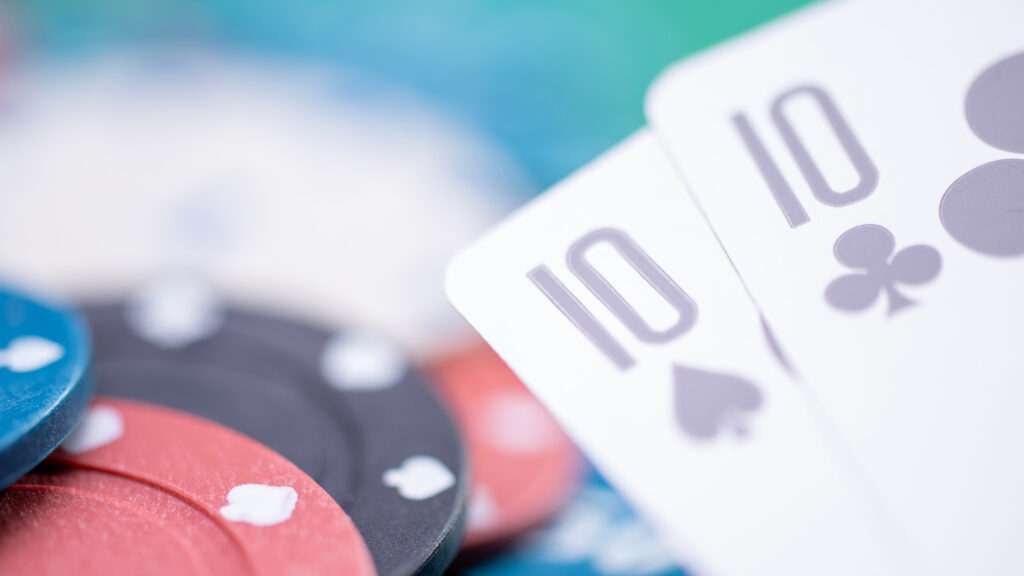
Cards rest beside stacked poker chips. Close-up shows ten of spades and ten of clubs. Chips vary in color-blue, red, black, and white. Focus sharpens on cards, background softly blurs
Don’t split 10s
Just because there are lots of 10s in the deck, don’t split them unless you are card counting and realize that it can be done advantageously. Otherwise, be satisfied with a close to unbeatable 20.
Hit on soft 17
No matter what, you should always hit on soft 17. You won’t go bust and have a better than 50 percent chance of improving or staying the same.
Don’t split 4s or 5s
This can turn a good starting combination into a bad one. That said, following basic strategy, you should double with two 5s against everything but a dealer 10 or Ace.
Always split Aces and 8s
Mathematically, as is shown on your basic strategy chart, this is the sounded decision with those two starting cards. And if you get a 2 or 3 on your 8s, you might be wise to double down, based on the dealer’s up card.
Give the game a whirl!
Ready to put your knowledge to the test? Go to William Hill to play online blackjack games that you won’t find anywhere else.
Blackjack FAQs
What is the basic strategy at William Hill based on?
Basic strategy is derived from computer simulations that determine the best blackjack play in every situation. These plays are all mathematically correct, but they do not guarantee that players will win.
How to memorize these strategies?
Playing blackjack and following the basic strategy guide will help with memorization. However, until everything is memorized, you should keep referring to William Hill’s guide in order to know the optimal moves.
How long will it take to memorize basic strategy?
This differs for each person, but, as you play, you will memorize bits and pieces until you have everything down cold and no longer need to refer to William Hill’s basic strategy guide.
What is the most important blackjack strategy?
Following basic strategy in its entirety is the most important way in which to reduce the house edge and have fun with the game of blackjack.
Blackjack hit or stand?
Always hit (and double or split when appropriate) on hands totaling 2 through 11
On hands of 12, hit against dealer 2, 3, 7, 8, 9, 10, picture card, and Ace; stand against dealer cards of 4,5, and 6.
On hands of 13-16, hit against dealer cards of 7, 8, 9, 10, picture card, and Ace; stand against cards of 2-6.
On hands of 17 and higher, stand against everything.
Please consult the basic strategy guide for splitting and surrendering on hands totaling 12-18.