Football
Final One Standing: Quarter-Finals Preview & Tips For Last Eight Stage
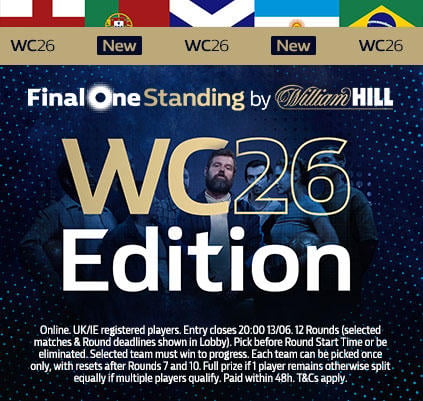
We are now at the business end of the tournament.
Every team left will believe they have a realistic chance of lifting the World Cup, but for Final One Standing players, the challenge is slightly different. This is no longer just about picking the most likely winner in each tie. It is about plotting your own pathway to the final.
That matters because the quarter-finals are not being played in isolation. Every decision you make now affects the options you have available in the semi-finals. There will be another reset before the Third-Place Play-Off and Final, but before then, there are two huge rounds to navigate — and one wrong move can undo weeks of careful planning.
With fewer than 6,000 players remaining from the nearly quarter of a million who started, the margins are getting smaller. At this stage, it is not enough to know who should win. You need to know when to use them.
This World Cup has already produced one of the most thrilling tournaments in recent memory, becoming the fastest to reach 100 goals since 1958, while averaging more than three goals per game. The drama has been relentless, and the next rounds promise more of the same.
Final One Standing: World Cup 2026 News
- Learn more about Final One Standing: World Cup 2026 Edition
- Tactics and Strategy Guide
- How to survive in Final One Standing: World Cup 2026
- Assessing The Pre-Tournament Favourites and Dark Horses
France vs Morocco
This is arguably the most intriguing tactical battle of the quarter-finals.
France arrive as favourites, with a 61.7% probability of victory, but that number should not disguise how difficult this tie could become.
Stylistically, it is one of the best matchups of the tournament: the competition’s most dangerous attack against one of its most disciplined defensive structures.
Les Bleus have carried a familiar tournament threat. They are explosive, experienced and blessed with elite match-winners across the pitch. France have produced the second-highest expected goals per 90 minutes of the teams still standing, while also leading the competition for goals scored.
Kylian Mbappé has once again been devastating. Seven goals, a 26.9% conversion rate and the constant ability to decide a match in one moment make him the obvious danger. But France are not simply reliant on Mbappé. Michael Olise has also emerged as a star, providing five assists while also averaging 2.49 through balls per 90 and 0.56 expected assists.
That variety is what makes France so difficult to stop. They can beat you with pace, width, combination play or individual brilliance.
Morocco, though, are built to frustrate elite teams. Four years on from their memorable semi-final meeting in Qatar, the Atlas Lions have another opportunity to test themselves against one of the deepest squads in world football.
Their defensive numbers are outstanding. Morocco are conceding just 0.10 expected goals per shot, the best figure among those still in the tournament. They also rank second for ground duel success and lead the tournament for clearances. This is not a side that gives up easy chances.
Crucially, Morocco are not just a deep defensive block. They are also capable of controlling possession when the game allows. They average more passes per sequence than France and only rank behind Argentina and Spain for sustained possession sequences.
That makes them more dangerous than a simple underdog story. They have structure, patience and enough technical quality to prevent France from turning the match into attack versus defence for 90 minutes.
The concern is availability. Injuries to Ismael Saibari, Chadi Riad and Issa Diop could leave Morocco short in both penalty areas, and against France, those details matter. Their margin for error is already small. Remove key players from the team’s spine, and the task becomes even harder.
Morocco will make this uncomfortable. They have the defensive organisation to frustrate France for long spells, and if the match is level entering the final 20 minutes, pressure will start to build.
But France still looks the more complete side. Their tournament experience and individual quality should eventually tell. They know how to win these matches, and with Mbappé, Olise and a bench packed with options, they have many ways to find a breakthrough.
France are my favourites to win this tie and remain one of the strongest candidates to lift the trophy. But that is exactly why this becomes a strategic decision.
Using France in the quarter-finals may get you through this round, but it could also remove your strongest semi-final option. If the draw plays out as expected, France are likely to meet Spain next. That would be a huge semi-final, but I would still favour Les Bleus to progress and potentially reach a third successive World Cup final.
For that reason, France may be more valuable later.
Norway vs England
This should be another excellent contest, but for very different reasons.
Norway and England have both carried major attacking threats throughout the tournament, yet they have arrived here in contrasting ways.
The Vikings’ campaign has been shaped by the ruthless finishing of Erling Haaland. England, by contrast, have quietly developed one of the most balanced statistical profiles in the competition.
And that balance could be decisive.
England are creating 1.98 expected goals per game while conceding just 0.84 expected goals. They have been strong at both ends of the pitch, but the real separation between the two sides comes defensively.
The Three Lions have limited opponents to just 0.08 expected goals per shot, which shows their ability to restrict high-quality chances rather than reduce shot volume. That is especially important against Norway, because stopping them is largely about limiting the service into Erling Haaland.
The Manchester City striker has been phenomenal. He is averaging 1.75 goals and 1.08 expected goals per 90 and has converted 38.9% of his shots. Those are extraordinary numbers at tournament level, and they explain why Norway are through to the quarter-finals stage.
But they also highlight the dependency.
Norway have relied heavily on his finishing to solve problems. Against weaker defences, that can be enough. Against England, the supply line is likely to be much harder to maintain.
Defensively, England looks well-suited to the challenge. Their superiority in defensive duels, organisation and control of central spaces should allow them to contain Norway’s biggest threat better than most.
Norway have problems at the other end.
Their defensive numbers remain a concern. They are conceding 1.63 expected goals per 90 — close to double that of England — and their ground duel success rate is one of the weakest in the tournament at just 42.6%. Against an England side with elite attacking options, that vulnerability is difficult to ignore.
This is where the match tilts.
Norway have the best individual striker left in the tournament, but England have the stronger collective structure.
The predictive data makes England a 1-in-2 shot (50.4%), which reflects how tight the match could be. But if they can effectively manage the threat of Haaland, they should create enough chances to progress, which makes England one of the best picks on this side of the draw.
However, they are not without risk, no team facing Haaland ever is, but their overall profile is stronger. The bigger picture also matters. The Three Lions’ route has opened up in their favour. Their likely semi-final opponent will come from Argentina or Switzerland, and neither looks as convincing as France or Spain on the opposite side.
Spain vs Belgium
On paper, this looks to be the most straightforward tie of the quarter-finals. But in reality, it is a fascinating clash between two teams who have arrived here by very different routes.
Spain remain one of the tournament favourites, not because they have overwhelmed opponents with goals, but because they have controlled matches better than anyone else. Belgium, meanwhile, have survived through resilience, moments of individual quality and a timely improvement in attack.
If France versus Morocco is attack against defence, then this is control against chaos.
Spain have quietly assembled the best defensive record at the World Cup. They are the only remaining side yet to concede, allowing just 0.30 expected goals per 90 minutes while leading the tournament for pressing intensity and averaging almost 66% possession. Their ability to dominate territory has suffocated opponents before they can build meaningful attacks.
The concern is in attack.
Despite their possession, Spain have not consistently translated it into high-quality chances. They rank among the tournament leaders for final-third passes and sustained possession sequences, yet they have underperformed expected goals in three of their five matches.
Their impressive goal tally has also been inflated by comfortable victories over Austria and Saudi Arabia, whose defensive records rank among the weakest at the tournament.
Against stronger opposition, those opportunities will inevitably become harder to create.
The Red Devils’ journey has been almost the complete opposite.
For much of the tournament, Belgium have looked disjointed, overly reliant on individual moments and lacking a clear tactical identity. Their performances attracted criticism, and rightly so. However, an emphatic victory over the United States hinted that something may finally be clicking into place.
Leandro Trossard has become the creative heartbeat of the side, leading the tournament for chances created while providing the imagination Belgium desperately needed. Even more encouraging is the team’s recent attacking output. Despite an inconsistent group stage, Belgium have averaged more than two expected goals per match and scored 12 goals across their last three fixtures.
There is, however, one problem that has never really disappeared. Defensively, they remain vulnerable.
Belgium continues to concede more than one expected goal per game and have relied heavily on Thibaut Courtois to keep them in matches. Losing Amadou Onana to an ACL injury only increases the pressure on an already fragile midfield, particularly against a Spanish side that specialises in dominating possession and forcing opponents to chase the ball.
Ultimately, this feels like a match that will be played almost entirely on Spain’s terms.
Belgium do possess enough attacking quality to punish mistakes, but Spain makes very few. Their ability to dictate tempo, deny transitions and patiently wear opponents down should eventually prove decisive.
And the predictive model agrees, giving Spain a 63.3% probability of progressing with a likely meeting with France in the semi-finals.
Argentina vs Switzerland
This is, without question, the most difficult tie to predict.
Argentina remain favourites according to the numbers (56.9%), but this is also the first time during the tournament where genuine doubts have begun to emerge around the reigning world champions.
On reputation alone, they should progress.
On current form, I am far less convinced.
Argentina’s performances have declined noticeably since the group stage. They escaped against Cape Verde after an unexpectedly laboured display before being pushed all the way by Egypt… The fluid attacking football that defined their opening matches has gradually been replaced by hurried deliveries into the penalty area and an increasing reliance on moments of individual brilliance.
Fatigue may also be beginning to play a part. Extended periods without the ball, combined with extra-time against Cape Verde, appear to have taken something from the side.
The underlying numbers support that observation.
Against Egypt, they attempted 19 shots but managed only seven on target. Against Cape Verde, they registered 22 efforts with just ten finding the target. They continue to dominate possession, but increasingly, struggle to convert that control into clear-cut opportunities.
Switzerland are exactly the type of opponent capable of exploiting that trend.
Tournament football has become something of an art form for the Swiss. They rarely dominate matches, yet they consistently frustrate opponents by remaining compact, disciplined and tactically intelligent. Every game is played on their terms, forcing favourites into uncomfortable, low-margin contests.
Cape Verde demonstrated the blueprint for causing problems for Argentina. Switzerland are arguably better equipped to execute it.
Defensively, there is little separating the two teams. Argentina have conceded just 0.60 expected goals per 90 compared to Switzerland’s 0.87, although the Swiss have actually allowed fewer goals overall.
But where Argentina still hold an advantage is in attack.
They continue to generate more expected goals, average more goals per game and, perhaps most importantly, still possess Lionel Messi.
Even at this stage of his career, Messi remains football’s ultimate insurance policy. His 1.10 expected goals and 1.76 goals per 90 minutes underline why Argentina are never truly out of any contest. They may not be playing particularly well, but they still have the one player capable of deciding a knockout tie with a single touch.
That is ultimately what makes this match so uncomfortable from a Final One Standing perspective.
Switzerland have every quality required to produce an upset. Their structure, patience and defensive discipline are perfectly suited to frustrating Argentina, particularly if the match remains level into the closing stages.
Yet backing against Messi in a World Cup knockout tie remains one of the most dangerous decisions you can make. And even if Argentina progresses, I struggle to see them going much further.